All News

Bear Grylls Is Running Wild: Which Celebrities Are Joining and How to Watch?
For years now, we have seen Bear Grylls chart numerous adventures across glaciers, varied mountain ranges, parched deserts, and even dense rainforests. Now, he is back with a rebranded show on Fox, titled Bear Grylls Is Running Wild, which is essentially the ninth season of Running Wild With Bear Grylls. Nothing can stop him from […]
This post belongs to FandomWire and first appeared on FandomWire
Apr 22
Ys Memoire: Revelations in Celceta Review
Adol of the Forest
Ys's Adol Christin is a pure and entertaining character; his passion for exploration endures no matter the location or situation. Finding himself without memories and an entire uncharted forest in Celceta to explore, makes everything feel new again for the adventurer. Under the title Ys Memoire: Revelations in Celceta , Nihon Falcom’s Switch remaster of Ys: Memories in Celceta offers a fairly straightforward but very fun adventure to be had. The isometric action RPG may start sluggishly, but it recovers recovers soon enough to become a fun entry in this long-running franchise.
The game starts with Adol passing out in front of the inn in the town of Casnan, later waking with no memory and being told of a friendly acquaintance, Duren. When a mine collapses and monsters flood the place, Adol's caring nature shines through as he drags Duren to save everybody. Meanwhile, the new governor general sent by the Romun Empire and leader of the fledgling mining town seeking out someone to map out the uncharted forests of Celceta surrounding the town. With Duren recalling that Adol has already been into forest, and they partner up to investigate Adol's missing memories while earning money from their explorations. The time spent with just the two of these characters extends too long, but when additional members join up with them, the plot doesn't give a lot of time to the new party members. Still, the quirky traits of those Adol meets combined with a generally light-hearted adventure continue to bring the smiles as the journey progresses.
While Adol can “speak,” his contributions to events are mostly flavour text that occasionally adds jokes and background to situations, which means his allies largely drive the story. There are five other party members that join the playable cast, each of whom has a fun but narrow-minded personality that makes for an enjoyable adventure. Duren ends up the punchline to everyone's jokes, while the rest of the cast are important people picked up from each village found on the journey. There's an overarching theme: Adol goes on a wacky excursion, a misunderstanding happens, and this leads to solving a village's local issue, which results in gathering more clues to solve the overarching problems of the whole forest. These main story beats don't tread any new ground, but when it's full of cute, endearing, and entertaining moments, it makes for enjoyable exploration to find the next village.
[caption id="attachment_189500" align="aligncenter" width="640"] Something tells me that this Adol character and ships get along swimmingly.[/caption]
The map of Celceta is interconnected by monoliths that dot the path, allowing teleportation between them. However, the early portions of the game limit the effectiveness of the fast travel, which means it still involves multiple screens of backtracking to a main hub to replenish resources. It does change later on around the same time that the story opens up, but that first burst of exploration is almost a third of the map completed before it becomes easy to traverse. Once the party and village count start to expand and the world starts to gain some urgency beyond Adol's memory recovery, everything starts to sink into place and exploration continues at an enjoyable clip that alternates between forest charting, dungeon diving, and quest fulfillment.
Sidequests in Ys Memoire: Revelations in Celceta generally either involve defeating a dangerous monster or bonding in an amusing event with an NPC while collecting some kind of resource. These moments make the world feel more lived in, and it’s a shame that the relevant party members don't get similar focus to the NPCs involved in the sidequests. Party members guest star as a voice for Adol, but they typically just engage in small pleasantries and ease introductions without really showcasing any of their personality. Additionally, sidequests are bunched together, often only appearing after the next village problem is completed, which leaves long periods where there's a singular focus on the main story beats with nothing else to do.
Players control one character while the other two active party members are controlled by the AI with basic attack or evade options, with the controlled character able to be swapped on the fly. Each character deals slash, pierce, and strike damage, with two party members assigned to each one. Many regular enemies have a weakness to one of the damage types, and will also yield more rewards when defeated with that type of attack. This makes it very useful to swap between characters often, other than just exploring their abilities and keeping things from feeling stagnant.
[caption id="attachment_189498" align="aligncenter" width="640"] Exploration has its fun slides to it for sure.[/caption]
Skills use a meter that recharges when damaging enemies that refills quickly, with new skills learned somewhat sporadically, often coming from controlling a party member against a tough foe. Up to four skills can be equipped at any time, mapped to face buttons, and initiated by holding down the R button on the top of the controller. This button combination occasionally does not recognize the trigger being hit, and characters end up guarding or dodging rather than using an attack. However, under the fast-paced system this generally just leads to taking a bit of extra damage, rather than it being a consistent problematic issue. A separate meter builds up to allow a special attack called an EXTRA, which slows down time and does a ton of damage, and is often best saved for boss fights. Overall, these systems provide some added enjoyment from swapping through characters and engaging in the routine combat. It is much more enjoyable to have that full party of possibilities rather than that first burst of exploration where minimal healing, few skills, and two party members lead to slow portions to go through.
The AI party members deal less damage, and are relatively safe from being harmed too much by the enemies, leaving it a mostly one-person show. Still, swapping between party members adds variety to attacks and skills, keeping combat fresh enough to stay enjoyable. Boss fights require dodging and parrying a bit more to stay alive due to their larger health pools, and often add in mechanics such as attacking pillars of energy to make the enemy vulnerable. These grand arena slugfests are a lot of fun, if a bit chaotic, as the busy motions can occasionally make it difficult to see where the character is for a timely dodge, or noticing they are looking the other direction for a special attack shot into nothing instead of a monster’s hide.
[caption id="attachment_189499" align="aligncenter" width="640"] Big explosions aplenty as the party tries taking down a boss.[/caption]
Enemies respawn on screen after around a minute of idling, or when transitioning between maps, which can lead to issues when trying to heal with an artifact, or when figuring out where to go next. Typically, just progressing forward will yield enough resources and experience to be worthwhile, so there’s no need to dawdle with grinding encounters. Ys Memoire: Revelations in Celceta has resource nodes that are found while exploring, though some materials can come from defeating enemies. These eventually have a use in creating consumables, refining gear, or crafting accessories, but for most of the game, they can be sold for additional funds or help with an odd side quest. Refining doesn't feel like it changes the usefulness of the weapons, while accessories are found organically from treasure chests.
Adol has a set of artifacts gained and unique actions for each party member that help with puzzles and basic dungeon traversal. Adol's skill is collecting his memories that manifest on screen as balls of light that distort the surroundings, and give a minor attribute boost while showing a brief glimpse of what came before. Duren’s skill is picking locks on chests, while the remainder of the party affect dungeons in smaller ways, such as breaking holes in weakened walls or charging up stations with magical energy. Artifacts have a variety of effects: some generate extra gold or allow for faster healing when standing still, while others work with environmental puzzles such as shrinking the party’s size or letting players dive underwater. One pleasantry is that these environmental puzzles appear frequently, making for enjoyable situations that are just a fun dopamine hit and vary up dungeon exploration.
[caption id="attachment_189501" align="aligncenter" width="640"] No one messes with the frog king.[/caption]
Ys Memoire: Revelations in Celceta does a good job of keeping the action moving on screen. There are no framerate drops from big flashy moves, but the visuals do feel muddled during frantic action sequences during boss fights. Environments have some varied details, but do not particularly stand out one way or another, beyond a lot of green used from the forest motif. Story cutscenes feel routine, and while the dialogue gets the story across commendably, the visuals are all in-game models that undercut the comedic and dramatic moments by feeling robotic. The soundtrack has a chaotic energy to it, and seems to lack a unified voice. This carries into location themes; one section of the map might have a quiet melodic tone, only to suddenly shift into a clash of guitar and violin that keeps the pace frantic. While the overall flow is disjointed, it is at least never boring and definitely keeps players guessing.
Adol Christin embodies adventure, and even with amnesia, there's a fun cast of characters and enjoyable combat surrounding him to carry through its thirty-hour length. Pacing issues do slow things down at the beginning, but once the story starts hitting that next gear, everything ramps up to match that enjoyably brisk pace. There are nitpicks that drag it down from being something truly special, but there's a perfectly serviceable action adventure in Ys Memoire: Revelations in Celceta . The story of Adol continues, and this outing will keep players interested in seeing where the winds take him next.
Disclosure: This review is based on a free copy of the game provided by the publisher.
The post Ys Memoire: Revelations in Celceta Review appeared first on RPGamer .
Apr 21
Beast of Reincarnation Starts Pre-Orders with New Trailer
Publisher Fictions and developer Game Freak announced that pre-orders have begun for action RPG Beast of Reincarnation . The game is available to pre-order physically and digitally for PlayStation 5, and Xbox Series X|S, as well as digitally on PC ahead of its release on August 4, 2026. It will also be included on PC and Xbox Game Pass subscription services.
Beast of Reincarnation will be available in a $59.99 Standard Edition and a $69.99 Deluxe Edition that includes 100,000 Amber (in-game currency), Brown Shiba and Black Shiba skins for Koo, and a Big Dipper weapon and Oni's Hat cosmetic for Emma. All pre-orders will also receive 30,000 Amber and the Brown Shiba skin for Koo. The news comes alongside a new minute-long gameplay trailer for the game that also shows the pre-order and Deluxe Edition bonuses.
Beast of Reincarnation is set in a post-apocalyptic Japan in the year 4026. It follows Emma the Sealer and her canine companion Koo. Emma is born with the blight, which lets her manipulate plants, but lacks memory and emotion, causing others to shun and fear her. As a Sealer, Emma is meant to hunt malefacts and absorb the blight into her own body. Their journey ends up taking them to the far west, where they must confront the eponymous Beast of Reincarnation said to be the source of all blight, through blighted forests created by giant malefacts called Nushi. Gameplay sees Emma fighting using her katana in action combat, with Koo able to support her with skills using a command-based system.
The post Beast of Reincarnation Starts Pre-Orders with New Trailer appeared first on RPGamer .
Apr 20
Outlander Season 8 Episode 8: Global Release Date, Time & What to Expect
Outlander Season 8 Episode 8 is almost here, and after the bruising events of Outlander Season 8 Episode 7, we do not think anyone is walking into “In the Forest” with a steady pulse. Last week gave fans two things at once: a long-awaited answer about Faith and a devastating farewell to Fergus. That is […]
This post belongs to FandomWire and first appeared on FandomWire
Apr 18
'90s Eco-Fantasy FernGully: The Last Rainforest Getting Live-Action Remake FernGully: The Last Rainforest is getting a live-action remake thanks to Amazon MGM Studios
Apr 17
Metro 2039 Preview – Grim Fiction Inspired By Darker Realities
Platform:
PlayStation 5, Xbox Series X/S, PC
Publisher:
Deep Silver
Developer:
4A Games
Release:
2026
Rating:
Mature
The Ukrainian-based 4A Games, developer of the Metro series, has been through hell since releasing Metro Exodus in 2019. Like all of us, it endured the hardships of the 2020 COVID-19 pandemic. But unlike most of us, it had an unfortunate front row seat to watch its country become embroiled in a brutal – and still ongoing – war with Russia. These experiences have profoundly affected the direction of Metro 2039, the fourth mainline entry in the post-apocalyptic first-person shooter franchise. If you’re new to Metro, the universe is inspired by the Metro series of novels by Dmitry Glukhovsky. The games largely take place in a post-apocalyptic Moscow, which, along with the rest of the world, has been destroyed by a nuclear war. Because of the nuclear fallout, much of humanity was forced to live in the city’s underground metro tunnels as dangerous mutated creatures inherited the irradiated surface. The series has been tonally heavy, but describing Metro 2039’s reveal cinematic as “dark” would be an understatement. As shown during a special developer presentation today, the trailer begins with a soldier, his face hidden by an oxygen mask, exploring a dark forest as an authoritative voice from a nearby megaphone commands him to wake up, promising clean air and a bright future. Children’s crayon drawings litter the ground, and as he picks one up, a small, red-headed girl appears in front of him. The soldier suddenly finds himself bound in a sea of chains; he sinks into them like quicksand as the girl watches unfazed. The soldier then arrives near a train, as other soldiers pack lines of chained children into its cars. Horrified, the soldier chases the train as it begins to disembark, the panicked cries of its young passengers spurring him forward before a chain around his ankle pulls him to the ground. The man awakens in a subway tunnel to find an old woman who tells him that everything is always about him; the man vehemently refutes this while demanding to know the children’s location. The sky lights up as Moscow burns from the nuclear war that creates Metro’s wasteland. A destroyed classroom filled with rows of faceless, brainwashed children chanting “the enemy must be destroyed,” as blood seeps from what would be their eyes. The arrival of the Dark Ones, the mutated foes from previous games, prompts the man to open fire, but his target winds up being one of the kids he was trying to save. 4A Games states that Metro 2039 will be a hand-crafted single-player story-focused experience. The protagonist is known only as The Stranger, a reclusive soldier plagued by violent nightmares, and who 4A Games confirms will be fully voiced. He must embark on a journey to a place he swore never to return: the Metro, the underground network of subway tunnels most of humanity calls home. Why The Stranger must do this, and what made him promise never to go back to the Metro in the first place, is still a mystery.
Previous Metro games explored humanity before and after the world collapsed, and the lengths people will go to survive one more day. Although Metro has always been a bleak window into the consequences of humanity’s shortsighted actions as a form of anti-war commentary, 2039’s tone is perhaps most informed by the real-life horrors 4A experienced during the Russia/Ukraine war. “Everything we had planned for the next Metro changed in 2020, and more significantly in 2022,” says executive producer Jon Bloch. Creative director Andriy Mls Shevchenko adds that the war with Russia shifted Metro 2039’s thematic direction to focus more on “the cost of silence, the horrors of tyranny, the price of freedom.” The team is doubling down on making choice and consequence matter. “We will go where the worst of humanity will be on full display,” says Schevchenko. Despite this direction, Ulmer clarifies that 4A does not want to romanticize or “make a theme park” out of the post-apocalypse. While the studio’s unique first-hand perspective of enduring the hardships of a real war – including the developer relying on battery generators for electricity and sheltering from rocket and drone attacks – will be reflected in 2039’s narrative, Shevchenko adds that this is still a Metro story. The game will mark a return to the tunnels of earlier games, though we don’t know if it will retain the more open exploration of Metro Exodus. A snippet of gameplay shows The Stranger exploring a richly detailed, bombed-out laundromat. Metro staples, like wiping grime off your protective visor, monitoring your wristwatch that displays your remaining oxygen, and listening to the familiar radiation ticker, are all present. An opening in the wall has allowed snow to partially blanket the room, burying the skeletal remains of humans and other creatures. As The Stranger goes to inspect a fresh body, he’s interrupted by the arrival of large mutants resembling werewolf-like moles. The Stranger bolts down an escalator, turning back only to take a single shot at his pursuer; like previous games, ammo must be scarce. The bullet barely registers as pain to the creature. It pounces on top of The Stranger, who must wrestle it to avoid getting his head ripped off by its gnashing, protruding teeth. The Stranger’s punch is reciprocated with a debilitating swipe by the mutant, and he manages a kick that provides just enough breathing room to lodge his knife through the mutant’s skull, killing it. The Stranger turns around to reveal he was at the doorstep of an underground shelter; soldiers pull him through the heavy doors, which close right before the other mutants can avenge their comrade. This brief gameplay section was impressively rendered and definitely has the hallmarks of what fans would likely want in a new Metro game. We’re excited to see this somewhat underappreciated series make a comeback, and while the subject matter won’t be for the faint of heart, we can’t wait to survive the horrors of its fallen world one more time.
Apr 16
Metro 2039 Preview – Grim Fiction Inspired By Darker Realities
Platform:
PlayStation 5, Xbox Series X/S, PC
Publisher:
Deep Silver
Developer:
4A Games
Release:
2026
The Ukrainian-based 4A Games, developer of the Metro series, has been through hell since releasing Metro Exodus in 2019. Like all of us, it endured the hardships of the 2020 COVID-19 pandemic. But unlike most of us, it had an unfortunate front row seat to watch its country become embroiled in a brutal – and still ongoing – war with Russia. These experiences have profoundly affected the direction of Metro 2039, the fourth mainline entry in the post-apocalyptic first-person shooter franchise. If you’re new to Metro, the universe is inspired by the Metro series of novels by Dmitry Glukhovsky. The games largely take place in a post-apocalyptic Moscow, which, along with the rest of the world, has been destroyed by a nuclear war. Because of the nuclear fallout, much of humanity was forced to live in the city’s underground metro tunnels as dangerous mutated creatures inherited the irradiated surface. The series has been tonally heavy, but describing Metro 2039’s reveal cinematic as “dark” would be an understatement. As shown during a special developer presentation today, the trailer begins with a soldier, his face hidden by an oxygen mask, exploring a dark forest as an authoritative voice from a nearby megaphone commands him to wake up, promising clean air and a bright future. Children’s crayon drawings litter the ground, and as he picks one up, a small, red-headed girl appears in front of him. The soldier suddenly finds himself bound in a sea of chains; he sinks into them like quicksand as the girl watches unfazed. The soldier then arrives near a train, as other soldiers pack lines of chained children into its cars. Horrified, the soldier chases the train as it begins to disembark, the panicked cries of its young passengers spurring him forward before a chain around his ankle pulls him to the ground. The man awakens in a subway tunnel to find an old woman who tells him that everything is always about him; the man vehemently refutes this while demanding to know the children’s location. The sky lights up as Moscow burns from the nuclear war that creates Metro’s wasteland. A destroyed classroom filled with rows of faceless, brainwashed children chanting “the enemy must be destroyed,” as blood seeps from what would be their eyes. The arrival of the Dark Ones, the mutated foes from previous games, prompts the man to open fire, but his target winds up being one of the kids he was trying to save. 4A Games states that Metro 2039 will be a hand-crafted single-player story-focused experience. The protagonist is known only as The Stranger, a reclusive soldier plagued by violent nightmares, and who 4A Games confirms will be fully voiced. He must embark on a journey to a place he swore never to return: the Metro, the underground network of subway tunnels most of humanity calls home. Why The Stranger must do this, and what made him promise never to go back to the Metro in the first place, is still a mystery.
Previous Metro games explored humanity before and after the world collapsed, and the lengths people will go to survive one more day. Although Metro has always been a bleak window into the consequences of humanity’s shortsighted actions as a form of anti-war commentary, 2039’s tone is perhaps most informed by the real-life horrors 4A experienced during the Russia/Ukraine war. “Everything we had planned for the next Metro changed in 2020, and more significantly in 2022,” says executive producer Jon Bloch. Creative director Andriy Mls Shevchenko adds that the war with Russia shifted Metro 2039’s thematic direction to focus more on “the cost of silence, the horrors of tyranny, the price of freedom.” The team is doubling down on making choice and consequence matter. “We will go where the worst of humanity will be on full display,” says Schevchenko. Despite this direction, Ulmer clarifies that 4A does not want to romanticize or “make a theme park” out of the post-apocalypse. While the studio’s unique first-hand perspective of enduring the hardships of a real war – including the developer relying on battery generators for electricity and sheltering from rocket and drone attacks – will be reflected in 2039’s narrative, Shevchenko adds that this is still a Metro story. The game will mark a return to the tunnels of earlier games, though we don’t know if it will retain the more open exploration of Metro Exodus. A snippet of gameplay shows The Stranger exploring a richly detailed, bombed-out laundromat. Metro staples, like wiping grime off your protective visor, monitoring your wristwatch that displays your remaining oxygen, and listening to the familiar radiation ticker, are all present. An opening in the wall has allowed snow to partially blanket the room, burying the skeletal remains of humans and other creatures. As The Stranger goes to inspect a fresh body, he’s interrupted by the arrival of large mutants resembling werewolf-like moles. The Stranger bolts down an escalator, turning back only to take a single shot at his pursuer; like previous games, ammo must be scarce. The bullet barely registers as pain to the creature. It pounces on top of The Stranger, who must wrestle it to avoid getting his head ripped off by its gnashing, protruding teeth. The Stranger’s punch is reciprocated with a debilitating swipe by the mutant, and he manages a kick that provides just enough breathing room to lodge his knife through the mutant’s skull, killing it. The Stranger turns around to reveal he was at the doorstep of an underground shelter; soldiers pull him through the heavy doors, which close right before the other mutants can avenge their comrade. This brief gameplay section was impressively rendered and definitely has the hallmarks of what fans would likely want in a new Metro game. We’re excited to see this somewhat underappreciated series make a comeback, and while the subject matter won’t be for the faint of heart, we can’t wait to survive the horrors of its fallen world one more time.
Apr 15
Cinnamoroll Leads Sanrio Character Ranking 2026 Popularity Poll Initial Results.
Sanrio shared the first update on the Sanrio Character Ranking 2026 popularity poll, and the initial results update on the official site shows Cinnamoroll in first place based on the votes that came in between April 9-12, 2026. Pompompurin, the 2025 winner , is in second place. Cinnamoroll previously won every year between 2020 and 2024, and we saw more merchandise of the character as a result. This is the first check-in on results, with the second one planned to arrive about 12 days before voting closes on May 24, 2026.
The current initial results update covers the overall top 10 right now, as well as the mascot in 41st place. Cinnamoroll is first, and Littleforestfellow is in 41st. Some staple characters, such as Hangyodon and Tuxedosam, haven’t made it into the top 10.
Here are the Sanrio Character Ranking 2026 popularity poll initial results based on April 9-12, 2026.
Cinnamoroll
Pompompurin
Pochacco
Kuromi
Hello Kitty
My Melody
Pekkle
Little Twin Stars
Hanamaruobake
Bad Badtz-Maru
There’s also a section breaking down the top five characters in different regions overseas, such as the US and UK. Here are the number one characters in different regions. While Cinnamoroll is number one overall, Pompompurin is still placing in first in many locations.
Australia: Pompompurin
Brazil: Cinnamoroll
Chinese Mainland: Pompompurin
France: Cinnamoroll
Germany: Cinnamoroll
Hong Kong: Pekkle
Italy: Cinnamoroll
Singapore: Cinnamoroll
South Korea: Cinnamoroll
Spain: Pompompurin
Taiwan: Pompompurin
Thailand: Yoshikitty
United Kingdom: Pompompurin
United States: Cinnamoroll
The next update will come on May 12, 2026. That’s when Sanrio will share the interim results. We'll see the final results on June 28, 2026.
Voting for the Sanrio Character Ranking 2026 runs between April 9, 2026 and May 24, 2026, and the final popularity poll results come in on June 28, 2026.
We may earn a commission if you purchase from certain links. Learn more here .
The post Cinnamoroll Leads Sanrio Character Ranking 2026 Popularity Poll Initial Results. appeared first on Siliconera .
Apr 14
7 Best Beginner Tips for Soulmask (Shifting Sands DLC)
Soulmask has finally launched with the 1.0 update, with the Shifting Sands DLC also going live. For those stepping into the dense and rich realms of Cloud Mist Forest or the Shifting Sands for the first time, the game’s mechanics may overwhelm you. From survival to tribe recruitment and brutal combat, there are a few […]
This post belongs to FandomWire and first appeared on FandomWire
Apr 13
Soulframe Is A 'Response To The Cynicism Of The World,' According To Digital Extremes
Warframe developer Digital Extremes is hard at work making its first game in nearly a decade, Soulframe , alongside the community in its early access “Preludes” form. To write the Soulframe cover story in the May issue of Game Informer , I traveled to Digital Extremes in Ontario, Canada, to learn more about the game, and it’s there that I learned this fantasy MMO is a response to the cynicism of the world. “To appeal to the sort of aesthetic or emotional reason for why we would make [Soulframe] is kind of a response to the cynicism of the world we are finding ourselves within today,” Digital Extremes CEO Steve Sinclair tells me. “And I think that is sharper than it even was when we started it.” He recalls reading a 2021 New York Times article about the appeal of The Lord of the Rings . It posits that the movie trilogy resonates with audiences so much because it shows men in touch with their emotions, and that people can be redeemed. “In this genre, generally speaking, it tends to be dark and sweaty and bleak and gross, and I love Game of Thrones as much as the next guy, but I think we wanted to put a little Disney Princess spin on this whole thing.” That’s why Soulframe, despite all of its video game-isms, doesn’t celebrate all of the killing you will have to do; instead, it saves that elation for the moments when you end corruption in the wilderness and restore various Omen Beast animals to their former harmonious states. Soulframe is ultimately about a hero who wants to stop an extraterrestrial enemy race from mining the world of Alca of is precious natural resources. If you hop into Soulframe Preludes today (reminder: Game Informer subscribers will receive a free code to do this as part of the issue rollout), you’ll find that your main quests revolve around saving those Omen Beasts and stopping Alca from polluting the natural wonder of this world with its machinery and industrialization.
“We’re not going to celebrate the destruction of human bodies and celebrate decapitations and other things you might see in the genre, but instead, try to bring a sense of touching grass,” Sinclair says, noting the irony in using that phrase, which typically means stop playing video games and go outside. “That’s kind of the big emotional push for why we think it’s worth making this game, even though Warframe is doing so well.” Soulframe creative director and former Warframe art and animation director Geoff Crookes says he believes the themes of this fantasy MMO are “a reflection of our age.” “It’s a reflection of how fractured we are,” Crookes adds. “There’s not a shared community anymore; there’s not a shared truth anymore. We’re not trying to heal the world, but if there are things that we can do in the game to encourage community-driven gameplay [...] that’s when we start to get excited about how the game can reinforce that.” Soulframe community lead Sarah Asselin says she sees comments all the time in Discord, on streams, and elsewhere that some players love to do “nothing” in Soulframe. “Even to just run around the forest and be immersed in this beautiful world we’re slowly building – it feels like this cozy and optimistic escape.” Sinclair says the strength of the early access Soulframe Preludes program is that Digital Extremes gets to put out various gameplay and content additions to test the waters of these themes and determine, with the help of its player base, whether the harmony the studio is looking for is present. Because Soulframe is the latest game to grace the cover of Game Informer , we’ll be posting behind-the-scenes stories like this alongside exclusive videos and more for the next few weeks. If you aren’t subscribed to Game Informer , you have until April 22 to do so and ensure a copy of this issue reaches your mailbox. Plus, anyone who subscribes will receive a Soulframe Preludes code to check out the game early. You can find more information about codes here . For more exclusive Soulframe insight, head to our hub here .
Apr 13
Pragmata Review - Hack And Blast
Reviewed on:
PlayStation 5
Platform:
PlayStation 5, Xbox Series X/S, PC
Publisher:
Capcom
Developer:
Capcom
Release:
April 17, 2026
Rating:
Teen
Third-person action-shooters have been around a long time, so it’s relatively rare that we see a wealth of new ideas at play. Pragmata’s greatest feat is successfully introducing a twist on the form, integrating two distinct mechanics – hacking and shooting – that run simultaneously in the midst of a fight. While Capcom’s long-awaited action game has some other problems, that single innovation keeps things interesting, even while some of the surrounding game treads familiar ground. Hugh is a specialist sent to a corporate moonbase where 3D-printed environments, bots, and other objects are researched and built at the direction of a morally questionable and profit-driven company back on Earth. After a disastrous arrival, he’s forced to partner with an uncannily advanced robot he names Diana, who just happens to look like an adorable little girl, complete with all the mannerisms befitting her appearance. With Diana capable of hacking the dangerous robots that hunt them, and Hugh equipped with ever-more devastating weaponry, the two navigate the mysterious moon habitat while blowing up increasingly towering automatons. Pragmata Video Review: Despite some early intimations that the story might be trying to say something about the hazards of AI or artificial experiences, Pragmata never really raises any thoughtful questions or draws any conclusions on that score. The scale of theming is smaller and more intimate here; Hugh and Diana make for a memorable partnership, and while the father/daughter dynamics are more than a bit heavy-handed, the emotional hook still lands. The space station environment is sterile and a little stale after the first few hours, but the setting is saved by the elaborate artificial spaces players move through as the plot unfolds, from a simulacrum of New York City to a holographic ocean shoreline. The juxtaposition of stark lab walls with objects like a 3D-printed forest that looks like the real thing creates an intriguing backdrop for encounters. Battles play out in tight arena-like spaces where several varieties of robots aim to take you out. Each foe has weak points, different attacks, and ways to protect itself. It’s fun to ferret out those characteristics and build mastery over the different encounters, even if the baseline shooting mechanics feel a little stiff and unwieldy. Diana’s hacking adds much-needed complexity. By aiming at a target, in addition to just blasting away with a gun, you can also use the face buttons to navigate a grid to hack and weaken that foe. Additional power-ups layer more ways to disrupt, delay, and destroy. It all happens in real time, so the challenge of juggling your hack with dodging and shooting foes can be a lot of fun, especially as the game throws more twists into the mix, like unpredictable enemies or grids that glitch as you navigate them. Pragmata guides players through a mostly linear critical path that risks feeling on rails. As such, I appreciate the way each area of the space station hides numerous hidden rooms, extra combat challenges, minor traversal jumping, and other secrets to discover and aid in progression. Sadly, the in-game map is unhelpful in navigating those spaces, so I often got lost, especially when returning to a zone after passing it, though at least a solid radar ping system helps identify item locations while exploring. In between battles, Hugh and Diana return to a shelter for character and weapon improvement, along with some extra daddy/daughter bonding moments. The respites are a pleasant change of pace that offers a steady sense of advancement, though I’m not crazy about having to return there every time I want to get my health, ammo, and heal charges back. The novelty of the dual mechanics starts to wear thin after a time, and some of the battles begin to feel repetitive in the later hours, so it’s a good thing Pragmata doesn’t wear out its welcome; a robust first playthrough hits the credits around 15 hours in and nails a satisfying conclusion. Between some challenging training missions, New Game +, and an extra post-game mode focused on battles and rewards for completionists, Pragmata pads out its offering into something more than just a single run. Gamers often complain that big publishers refuse to roll the dice on new properties with unique systems; I give Pragmata big props for doing precisely that and experimenting with something unconventional. The story and structure as a whole feel a bit by-the-numbers, but the beautiful futuristic visuals and inventive battle system are solid wins.
Score:
8
About Game Informer's review system
Apr 13
Cats & Soup Teams up With Sanrio for a New Adorable CollaborationCats & Soup is getting new adorable collaboration, bringing the globally loved Sanrio characters into its cozy forest setting.
The post Cats & Soup Teams up With Sanrio for a New Adorable Collaboration appeared first on COGconnected .
Apr 11
GreedFall: The Dying World Review
Going Native
It's been seven years since players were first given the opportunity to join a band of adventurers and set sail to the mythical continent of Teer Fradee in order to track down a cure for a destructive epidemic running rampant in their homeland. Now, with GreedFall: The Dying World , developer Spiders is taking players back to before it all started, this time viewing the events unfolding on Teer Fradee from the perspective of its native people, who are forced to watch helplessly as strangers come to their shores, colonize their land, and subjugate their people. Though the narrative is laudable both in terms of its uniqueness and for mirroring similar real-world conflicts from the colonized's point of view, the game falls afoul of some of the same shortcomings as its predecessor and, in the case of its revamped combat system, even makes some new missteps all of its own.
Players create and take on the role of a native islander of Teer Fradee, choosing not only the character's appearance but also their gender. Named Vriden Gerr by their tribe, they are undergoing training to become a doneigad, a type of shaman who communes with the spirit of the land. As Vriden Gerr's training enters its final stages, events surrounding their village begin to spiral out of control. Strangers have recently begun arriving on their island, intent on colonizing it and clashing with the natives in the process: forests and rivers are beginning to run dangerously low on wildlife to feed the many additional mouths, and the strangers' mining operations are beginning to have adverse effects on the tribe's hunting grounds.
This early-game section on Teer Fradee functions as a tutorial of sorts, exposing players to the finer points of combat, stealth, and the diplomatic options baked into the game's dialogue system. Regardless of how players approach things, however -- whether trying to keep the peace between their tribe and the newly arrived interlopers or willing to let things spiral toward hostilities -- the intro ends with the protagonist and their companions brutally ambushed by the colonial settlers and locked up in cages aboard a cargo ship en route to the continent of Gacane, to be studied and scrutinized for their innate resistance to the Malichor epidemic. Though one of their companions tragically dies during the voyage, Vriden Gerr and fellow islander Nilan are soon sprung from prison by a group of ragtag outlaws who abhor this inhumane treatment of the natives. Thus begins the game's main narrative, which sees players first looking for a way back to their homeland and, later, protecting it against the remorseless machinations of General Kurnaz, the game's main antagonist.
[caption id="attachment_183040" align="aligncenter" width="640"] This time, players will be steeped in the customs and culture of Teer Fradee's natives.[/caption]
Since Vriden Gerr isn't alone on this journey, the supporting cast of characters is pretty important. The game features seven companions that accompany Vriden Gerr, and doesn't hold back long to throw them into the narrative mix. The prison break immediately following the intro chapter piles most of them into the player's party right off the bat, with the final two unceremoniously coming along shortly after. There is little time to get to know most of them before they join forces, leading them to feel like woefully interchangeable placeholders much of the time. In fact, the burly Till, a captain of the Coin Guard and one of the final companions to be acquired, joins the group during an in-game cinematic event without a proper introduction or even any dialogue whatsoever, leading to a confusing subsequent scene where the characters are already referring to their shared adventures before he had even been introduced by name.
Sadly, Till is not the only companion to be underserved by a lack of initial characterization, with much of the party's background being locked behind their individual loyalty quests, which are not only optional but, in some cases, also expire entirely at certain points in the story, and honestly do little to endear them to the player. GreedFall: The Dying World takes much of its inspiration from other Western RPGs in the vein of Dragon Age and other classic BioWare titles, which is partly evident in how the party roster loosely impacts the unfolding narrative. Companions will approve of or disagree with the player's choices along the way, raising or lowering their affinity with Vriden Gerr. Completing their loyalty missions and forging strong bonds with them may unlock them as potential love interests, whereas displeasing them may result in them abandoning the party altogether. Based on their individual backgrounds, each party member also has certain moments within the narrative where their expertise may present an alternate solution to a problem, such as a companion having influence over hostile members of the guild of Nauts, circumventing what would otherwise have resulted in a bloody skirmish.
[caption id="attachment_184512" align="aligncenter" width="640"] This is Till. He's about to join the party. Good luck finding any of that out though.[/caption]
The game world spans three major cities and their surrounding areas, each divided into distinct districts. Much like the at-times bland cast of characters, there is little about these hubs that invites deeper exploration. That's not to say that they are lazily designed; the developers have certainly taken pains to pack a lot of visual detail into the environments. However, there is simply nothing to actually do in any of them other than run through and get into the occasional, equally uninteresting scuffle. There is little reason to forego usage of the game's fast-travel system, but the remote placement of quest objectives and sheer amount of back-and-forth pinballing that is required to complete them mean that traveling of any kind is usually a chore. Visiting and revisiting the same locations ad nauseam just to talk to the same NPCs over and over again simply isn't engaging or fun by any stretch of the imagination. At least there are a small handful of quests over the course of the game that conjure up a more interesting interaction. For example, a couple of dungeons ask the player to solve environmental puzzles, such as digging through a bit of local folklore and matching certain items with particular statues or activating switches in a predetermined order; there's even a standout sidequest that sends the party on a riddle-based scavenger hunt all throughout the Naut city of Uxantis.
For the vast majority of the game's runtime, however, combat is the player's sole constant companion. In The Dying World , the developers have taken a step back from action-based battles and implemented a system more akin to real-time-with-pause. While players can opt to focus their attention on controlling only Vriden Gerr during combat and letting their companions run on autopilot, there are also options for pausing the combat at any point and issuing commands or even switching control over to a companion completely. Obviously, such a change in combat design will appeal to some more than others, but there is such a glut of extraneous mechanics to come to grips with that combat never feels smooth or satisfying in the least.
[caption id="attachment_179689" align="aligncenter" width="640"] The setting dictates lots of swords and guns in combat, but some characters also make use of mystical powers.[/caption]
To start with, the party seems perfectly capable of wearing down at least 95% of all encounters in the game without further interference from the player. This is a good thing, since learning each combatant's abilities and proclivities just isn't enjoyable. For one, the way the companions are unceremoniously dumped on the player all at once means there's simply no time to get to know each of them as a separate battlefield entity. Each companion has access to three unique skill trees, one for their class, one for their preferred weapon, and one specific to them as an individual (by comparison, Vriden Gerr, being a blank slate for the player to shape, has access to most of them). This means memorizing which companion has which abilities mapped to what button shortcuts is an exercise in ridiculousness, particularly when brute-forcing combat is almost always a better alternative. Then there's the speed at which combat moves, which would require constant sifting through menus and switching perspectives all over the battlefield to stay on top of. Most telling of all, however, is the fact that, even if one tries to exert control over the party, their AI has a tendency to override commands issued to it. Issuing an order for the party to jump out of the way of a boss's AoE attack, for instance, may result in some allies clearing the danger areas while others continue to wail away on the foe, heedless of the danger.
Whereas almost any encounter can just be slogged through on autopilot, there are a handful of battles that are curiously unbalanced, typically pitting the combat party of four against unfair numbers that simply overwhelm them through sheer force. Thankfully, there exist a couple of sliders in the options menu that allow players to fine-tune certain combat variables on the fly, like separate sliders for how much damage allies and enemies deal and whether friendly fire registers. It may be a poor consolation prize to having an enjoyable or well-implemented combat system, but at least these options ensure that no player will ever become truly stuck on any battle scenario.
The game's presentation is a bit of a mixed bag. As previously mentioned, there is a good amount of detail worked into the environments, though the color palette tends toward the brown and drab. While this certainly may be a stylistic choice and may even make some sense in the faux-historical context, it isn't often very nice to look at. Character models look fine, but there's little about them that stands out. At least the game's voice actors perform their roles fairly well, and probably add the lion's share of characterization to the cast, but even they aren't often up to the task of breathing life into the harsh fictional language of the Teer Fradeeans, which is (understandably) heavily favored by any native characters but often sounds wooden and recited straight from the script. The game's music does generally fit the bill quite well, being a good match for its mix of historical real-world colonization, with the occasional touch of the fantastical thrown in.
[caption id="attachment_179704" align="aligncenter" width="640"] The world is pretty. Pretty brown.[/caption]
Given the scope of GreedFall: The Dying World and the small-sized development studio it originated from, it seems inevitable that the game would also sport at least a few technical hiccups. In addition to AI-controlled companions having a tendency to follow the beat of their own war drum, there were a handful of times during the review playthrough that combat would initiate with only Vriden Gerr as an active combatant, while all other companions became spectators from outside the combat arena's radius, or stuck around a corner and somehow unable to find their way to the action on their own. A far more puzzling oversight was when a party member, having been allowed to perish earlier in the narrative, suddenly showed up again near the game's end in a dialogue scene where each companion was allowed to weigh in one last time before the game's final showdown. Equally odd was a completely different fallen party member also managing to return from the dead during the post-game, when the world opens up one final time for traversal despite there being nothing to do, with all quests, sidequests, and loyalty missions being permanently disabled by then.
It all adds up to a game that's more commendable on paper than in its execution. GreedFall: The Dying World is an ambitious title by a smaller developer that tells a story from a perspective not often seen in the medium. A story about the horrors of colonization, not to mention told from the point of view of the colonized, is a laudable endeavor. But there isn't much about the game that makes it a fun outing. Characters lack personality, and it's entirely up to the player to seek it out where it exists, combat is an overly complex mess of options layered on a foundation made for brute-forcing, and both presentation and technical optimization are in need of fine-tuning. With the change away from the more action-oriented combat being a questionable one, fans of the previous installment may still be on board for another chance to visit the world of Teer Fradee, while all others may want to miss the boat this time around.
Disclosure: This review is based on a free copy of the game provided by the publisher.
The post GreedFall: The Dying World Review appeared first on RPGamer .
Apr 10
Alkahest Receives Debut Gameplay Trailer
Publisher HypeTrain Digital and developer Push On released a debut gameplay trailer for action adventure RPG Alkahest . The minute-long video shows an assortment of short clips from the game, including players using the environment and alchemy to help defeat enemies.
Alkahest sees players controlling the youngest son of a petty lord in a fantasy realm, looking to make a name for themselves by investigating unusual goblin raids. Players explore castles, forests, villages, caves, and ruins while meting residents and fighting foes in fast-paced combat and interactive environments. The game is in development for PC, PlayStation 5, and Xbox Series X|S.
The post Alkahest Receives Debut Gameplay Trailer appeared first on RPGamer .
Apr 9
Bylina Releasing on PC This Month
Publisher Digital Vortex Entertainment and developer Far Far Games announced that isometric action adventure title Bylina will release on PC on April 20, 2026. The PC version of the game will be available through Steam . PlayStation 5 and Xbox Series X|S versions were planned under the game's previous publisher, but have not been dated.
Bylina is based on Slavic myths and folklore. It follows Falconet, a young bogatyr (effectively a wandering knight) who is born without heroic powers and shunned by those around him. He finds himself in the Far Far Kingdom, where a mysterious spirit ends up sharing his body. The game sees players exploring various locations, from sunlit forests to gloomy dungeons and castles, that have their own strange inhabitants, challenges, treasures, and puzzles.
[foogallery id="188628"]
The post Bylina Releasing on PC This Month appeared first on RPGamer .
Apr 8
Game of Thrones: 8 Mysterious Wildling Clans the Canceled Jon Snow Spinoff Could’ve Explored, Ranked
The Jon Snow spinoff series may not happen in the foreseeable future, and it’s sad to think that we won’t have a fitting place anymore to explore the Wildling clans of the frostbitten forests and shadowy mountains beyond the Wall. While the Free Folk had a significant amount of screen time in Game of Thrones, it […]
This post belongs to FandomWire and first appeared on FandomWire
Apr 5
Wanderstop Developer Ivy Road Is Shutting Down Tomorrow
Ivy Road Studios, the team behind last year’s well-received narrative shop simulator Wanderstop , is closing its doors tomorrow, March 31. The team announced the news this past Friday. The studio was founded by Davey Wreden, known as the creator of The Stanley Parable and The Beginner’s Guide . In a website post , the team explains that it was unable to secure funding for its next project, known as Engine Angel. Because of this, the studio must shut down. “It's a particularly tough time for raising game funds, so while we weren't necessarily surprised, we are disappointed that we won't be able to bring Engine Angel to life together as a team,” reads a section of Ivy Road’s post. The team also provides a link to a 35-second concept video showing off what looks like a whimsical car combat game. As for what this means for Wanderstop, the game will remain available for purchase on each platform it’s listed on, and owners will still be able to download and install it. Ivy Road also reveals that it has been working on one final surprise for the game to help it reach new players. Publisher Annapurna Interactive will share more about what this is in the future. In the meantime, Ivy Road shared a chapter select code that will allow players to revisit specific chapters in Wanderstop or serve as a remedy to players who get stuck. This is activated by typing in the following command at the game’s main menu screen using the d-pad: UP, LEFT, DOWN, RIGHT, UP, B (RMB), UP, RIGHT, DOWN, LEFT, UP, B (RMB), UP, DOWN, UP. Wanderstop stars a retired warrior named Alta who begrudgingly helps manage a tea shop in a magical forest. Although the game sports cozy mechanics, such as harvesting ingredients to brew teas and managing the store and its whimsical customers, it’s a narrative-focused adventure that centers on Alta’s mental health stemming from her fighting days. Executive Editor Kyle Hilliard scored Wanderstop an 8 out of 10 in his review, in which he writes, “I admire the game for being able to use video game genre conventions to tell a pensive, funny, and surprising story set in a charming location with enjoyable characters. Watching Alta grow and accept her limitations will stick with me and make me reflect on my own inability to turn off and just relax. I appreciate any art that makes you think in that way, and Wanderstop is successful in that goal.”
Mar 30
Review: Otome Daoshi Leans Into Anime and Manga Aesthetics
Otomate and Idea Factory otome visual novels can often follow the same sort of gameplay patterns and decisions, so it’s always fun to see something a little different. Otome Daoshi: Fighting for Love , Aksys’ latest pick-up, is a fantastic example. It is a new game from all three and, while it is still a traditional visual novel, it leans into the martial arts themes by also incorporating some anime and manga design directions. However, in the process we lose some of the standard otome visual novel niceties.
As Otome Daoshi begins, it feels a little like we’re being set up for something that might feel a bit like an otome game with a Dragon Ball style 21st World Martial Arts Tournament setting. Shunlin is a martial artist who is also training to be a daoshi. However, while she’s preparing to attend the Tournament of Valor with her grandfather and older brother figure (and possible love interest) Haoran, disaster strikes. Undead jiangshi, the exact types of entities daoshi take to the Forest of Chiming Souls to keep the dead from being abused or harming the innocent, appear and attack. Shunlin and other individuals there to attend or compete in the event, like love interests Longli, Shaowu, and Yuhang, get caught up in investigating and saving the day, while falling in love along the way.
https://www.youtube.com/watch?v=URSEVCsL8HE
In terms of execution, Otome Daoshi plays like a standard visual novel. You make choices and read along with the story. Rather than your degree of affection determining which route you end up on, you flat out select whose story you pursue after getting to a certain point. You can’t end up with a bad ending, but one of the two ends for each bachelor is a “true” one. While five characters are available, only Haoran, Shaowu, and Yuhang are available on the first run. Longli only unlocks after you finish all three of their stories, and you then must finish his for the secret character whose identity is incredibly obvious. All the routes are pretty short, which means it ends up being about two to four hours to finish a storyline depending on how quickly you read or much you enjoy a path.
Here’s the downside though It isn’t so much that these are shorter runs. It’s that they aren’t as well developed as other otome games Aksys picked up. Like Mistonia’s Hope is one of its other recent releases that blends love stories with subterfuge and revenge. In most of the routes, all elements are well developed and sometimes there’s an unexpected twist. I felt like I saw every plot point coming in Otome Daoshi, and the nature of the narrative means that each character’s story feels rushed with some unresolved elements. Shunlin and some of the guys fall in love way too fast for the sake of the story, with only ones like Haoran and Yuhang feeling like that element makes more sense because both knew her before the events of the game. We might see some of the mystery elements wrap up too quickly or not handled as well in some paths. It’s a bit frustrating.
Which is especially frustrating since the presentation is really pretty! The character designs are fantastic. The backgrounds look good. There are story elements where manga koma are used to show what’s going on. That’s especially great, since it suits the idea of the martial arts masters and attacks against enemies so well.
Screenshots by Siliconera
Especially since there are other downsides to Otome Daoshi come up tied to its presentation and gameplay. Some of these sorts of games end up with extra touches that make things feel a little more finished or alive. For example, the character portraits may have some live 2D elements or animations. That doesn’t happen here. We only see static portraits. We don’t get a glossary section, which seems odd given the number of important terms like “daoshi” or “jiangshi.” There’s also no option for a voiced heroine. That’s something that isn’t always as common, so it’s a little less surprising to see it’s gone. But when combined with the lack of other features, it adds to the feeling of this release not being at the same level as others from the company.
What is disappointing is the lack of an audio or visual indicator that you made a “right” choice when going through a route. See, a common element in Otomate and Idea Factory otome games is some acknowledgement in-game when a response comes up that lets you know if you made the choice that sends you toward the best ending by playing a small animation or having a sound effect play. (Idea Factory, in particular, has referred to it as the Love Catch System for years, and it’s even included as a setting you can toggle in the options of some titles.) Oddly enough, it isn’t here! You can go into the menu to check the Affection ranking after getting to a certain point in the story. (That feature is unselectable until you do.) And we are setting ourselves on a route by choosing a person after getting through a point in the introductory common route. But I’m always disappointed when it isn’t around.
While Otome Daoshi: Fighting for Love’ s story isn’t as exciting as I expected a martial arts otome game to be, there are some romantic routes here. Playing it safe isn’t a bad thing, though it does mean it might feel a little more predictable than other titles in the genre. I wish it featured some quality of life titles from other Otomate titles. However, the way it does go with the theme and include the same sort of ambiance and elements as martial arts anime and manga is a nice touch.
Otome Daoshi: Fighting for Love is available for the Switch.
The post Review: Otome Daoshi Leans Into Anime and Manga Aesthetics appeared first on Siliconera .
Mar 30
Robot Recycler Ryn Interview
Who doesn't love building robots and seeing how they'd fare in combat situations? Robot Recycler Ryn from Rablo Games makes building robots an intimate part of the game creation, as every part is built with time and consideration, while creating the party for players to take on the Recycler Rumble League and go exploring a post-apocalyptic world. Joining RPGamer today is Pablo Coma, the Founder of Rablo Games, to talk about the game and how its mechanics will work, before it releases on Steam with a Q4 2026 release window.
Ryan Costa (RPGamer): Robot Recycler Ryn mixes an intriguing action-based combat and an intricate crafting system. Which part of the gameplay game first, or were the two always meant to be in tandem?
Pablo Coma : The base idea for the project was to create a spiritual successor to Healer’s Quest , but instead of healing people, the player would repair robots. So, initially it was the combat system that came first in my head. But after letting the idea mature for a few months, it became clear to me that construction gameplay would fit perfectly with the combat we intended to create. I started designing how the game idea could evolve in that direction, even visiting a machining school to get a real grasp of how everything could work together while staying as close as possible to real world materials and machining. The construction aspect ended up becoming increasingly important in the gameplay throughout development, up to the point where we decided to include a construction mode in addition to the classical story mode.
RPGamer: Combat has the option for active or auto. What would be the best recommendation for how to utilize either style for new players?
PC : The active battle mode is the way we originally wanted the game to be played. I also believe it’s more innovative than the auto-battler mode. In active mode, you directly control the character, you can run around the battlefield, avoiding enemy shots and explosions, while taking cover behind your robots to repair them. If you repair them from the front side, you repair twice as fast, but you are much more exposed to enemy shots. You can also kick grenades back to the enemy team, perform maintenance on your robots and use various gadgets allowing you to keep your robots up and running.
The auto-battle mode removes most of the interactivity. It is designed for players who like to be hands-off while watching your team do all of the hard work for you. It also works very well because it gives a lot of importance to the care you put into the construction phase and your strategy in assembling the different robotic limbs.
For players who prefer a strategic approach, I would recommend the auto-battle mode, otherwise I suggest you try the active battle mode. But you can switch between the two modes at any point during your game if you want to try the other option.
RPGamer: Crafting has a lot of visual variety. How lenient is the game when it comes to design decisions for robot parts? Does understanding the mechanics play an important role in ensuring players get the benefits from them?
PC : The base rule is that every robotic limb can be combined. We do not restrict anything, but there are definitely some aspects that the player needs to take into consideration when creating their robots. For example, if you put a very heavy body and gigantic machinegun arms on top of small legs, the stability of the robot will be impacted, which will give you a debuff in combat or even prevent your robot from being able to fight. If you really want to use that huge body on those tiny legs, nothing prevents you from doing it, but you may have to build it using lighter materials, like aluminium instead of zinc, or include something like a helicopter head, which allows for heavier robots to work properly by increasing the mass supported.
Material will also have an impact on how fast your robot overheats during combat, so picking the right material is definitely an important decision when starting the construction of new limbs.
RPGamer: Does the world revolve around the Recycler Rumble League, or are there other forces at work as well?
PC : In this devastated world, leaders are elected through a combat robot league named Recycler Rumble League. You play as Ryn, a girl whose sister defied the current leader in the League and lost under weird circumstances. To rescue her, Ryn will have to follow in her footsteps, learning the way of being a Recycler (the only people capable of creating machines in this world) and climbing the ladder of the League. This is the common thread which drives the story, but Ryn will also have to complete her training with Master Ten, the mentor who taught her sister to be a Recycler. So she will also have to explore various dangerous places, like the abandoned metro station and the metal forest, where she will have unexpected encounters.
RPGamer: Will players be able to obtain new methods of crafting a larger variety of mechanical limbs?
PC : By progressing through the story, the player will discover blueprints and acquire new materials, so the amount of different limbs you can craft and their capabilities will constantly evolve as the player progresses into the story.
Crafting robotic limbs also increases your Recycler level, allowing you to upgrade your tools. For example, it will be possible to display the blueprint directly on the piece you’re sculpting using the lathe, the rotating saw could evolve into a band saw and the soldering iron can become more precise. Some of these upgrades will be necessary for crafting advanced limbs.
RPGamer: How many different steps will there be while creating the parts for the mechanical limbs?
PC : The construction part of the game is divided into 3 phases.
In the first phase, you build the frame, the structure of the limb by assembling, welding and connecting different spare parts you found while exploring the world.
Once this is done, the second phase consists of creating the shell of the robotic limb. This is the most important phase, as you get to choose the material you would like to use, and to create every part of the shell piece by piece, using all the tools in your workshop. This phase is itself divided into different workshops, as the player will have to use the blowtorch, saw, soldering iron, hammer, bench, lathe and more. At the end of the second phase, a score is given to the limb and its statistics are affected proportionally. A limb crafted with care will be more effective in combat than one that has been rushed.
In the third phase, you assemble the limbs into powerful combat robots. That’s the point where you should pay attention to each limb’s mass, stability and other aspects to make sure your robots are working properly. Once everything is set up, name your robots and pick up to three of them to add to your team.
RPGamer: The previous games in your developer catalogue ( Healer's Quest and Necro Story ) had a penchant for comedy. Will that tradition continue with Robot Recycler Ryn ?
PC : We’ve included some humor in Robot Recycler Ryn too, but not as much as in our previous games. The overall atmosphere is more serious in Robot Recycler Ryn , even though you can expect to meet some funny characters.
But we definitely plan to come back to crazy comedy-focused games in the future.
RPGamer: What happens when the player's party of robots lose in combat?
PC : You will be brought back to your village, where you build robots, and your team will be automatically repaired. If you were exploring a dangerous area - a dungeon - you will have to restart the exploration of that area from the last checkpoint. But you will keep all materials and spare parts you found during your exploration, so you can use them to craft new robots before trying again.
RPGamer: How creative can players get within the combat system if they play in active mode? For example, how can Ryn deal with debuffs such as the icicle one of the robots finds themselves in during the trailer?
PC : To deal with debuffs and customize their combat experience, players can equip multiple gadgets. Some of them are a bit similar to spells in Healer’s Quest , like an auto-repair device which will repair a robot over time for a few seconds, or having your mini-robot Kinshoo call its friends for help. Other gadgets give you ways to deal with debuffs, like a fire extinguisher for burning robots, or an anti-aerial beacon which will cancel all mortar shots currently threatening your team.
You also have access to a skill tree where you can customize various skills and abilities, such as increasing the repair speed from the front side of a robot, increasing your character’s armor (Ryn can also die!) or giving new abilities to your mini-robot, Kinshoo, so that it can help you during combat. There’s a whole part of the skill tree dedicated to Kinshoo.
RPGamer: How will exploration work during Ryn's journey in story mode?
PC : The player will use a world map to select the destination they want to explore. Once there, there will likely be rogue machines ready to attack you, so the player should explore carefully while avoiding encounters, unless they seek them out to gather new materials. By exploring carefully, you can also find chests containing materials and blueprints for new robotic limbs.
There are different levels of difficulty available for every location, with bigger rewards if a harder difficulty is selected.
RPGamer: What is something that you would love to share about the game not discussed above?
PC : Up to now I’ve always worked on game projects alone or in a team of two. This is our most ambitious project so far, as there were three of us working full time on it. We wrote a full story based on this post-apocalyptic world and the work of Recyclers, and we hope players will enjoy it. But for players who are less interested in the story and exploration and just want to create wacky robots, we also made a Construction mode. It removes all the story and exploration from the game and simply lets you build robots, then test them in optional combat for fun. With that, and the choice between active battle and auto-battle modes, we tried to make a game you can enjoy in the way that suits you best.
Thank you for reading, and a big thanks to RPGamer for the interview.
RPGamer would like to thank Pablo Coma for their time in answering these questions about Robot Recycler Ryn , as well as Sarah Blackwell and Stride PR for making it possible. Those looking to build and maintain robots won't have long to wait, as it is aiming to release in Q4 2026 on Steam . RPGamers can also take a look at an impression of an early demo build here .
The post Robot Recycler Ryn Interview appeared first on RPGamer .
Mar 30
Infinity Nikki 2.4 Arrives With a New Mysterious StorylineInfold Games has officially released the version 2.4 update for Infinity Nikki, titled The Forest Need Not Listen.
The post Infinity Nikki 2.4 Arrives With a New Mysterious Storyline appeared first on COGconnected .
Mar 29
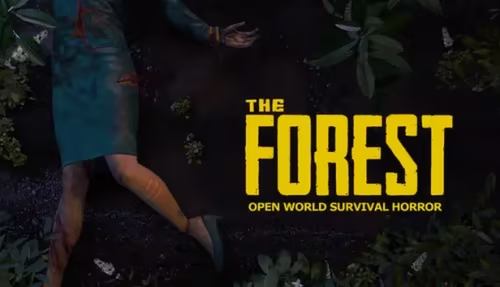
The ForestAs the lone survivor of a passenger jet crash, you find yourself in a mysterious forest battling to stay alive against a society of cannibalistic mutants. Build, explore, survive in this terrifying first person survival horror simulator.



